Readings on Content Knowledge of Linear Equations and Functions for Students
For many students in Grades 8 and up, the numbers and shapes they've learned about actually beginning to come together when they are making and solving linear equations. This topic integrates ideas almost algebra, geometry, and functions and can be difficult for many children—and adults!—to wrap their heads around. This article explains what a linear equation is and walks through unlike examples. Then it offers lesson ideas for introducing and developing the concept of linear equations in one variable to your students.
What Is a Linear Equation?
Just similar whatever other equation, a linear equation is made upwards of two expressions prepare equal to each other. There are some key features common to all linear equations:
- A linear equation simply has 1 or two variables.
- No variable in a linear equation is raised to a power greater than ane or used as the denominator of a fraction.
- When you lot find pairs of values that brand a linear equation truthful and plot those pairs on a coordinate grid, all of the points prevarication on the same line. The graph of a linear equation is a straight line.
A linear equation in two variables can be described equally a linear human relationship between ten and y, that is, ii variables in which the value of one of them (usually y) depends on the value of the other one (usually ten). In this case, ten is the contained variable, and y depends on it, then y is called the dependent variable.
Whether or not information technology'south labeled ten, the independent variable is usually plotted along the horizontal axis. Most linear equations are functions. In other words, for every value of x, there is merely one respective value of y. When you lot assign a value to the contained variable, x, you can compute the value of the dependent variable, y. You can and so plot the points named by each (10,y) pair on a coordinate grid.
Describing Linear Relationships
Students should already know that any 2 points determine a line. And then graphing a linear equation in fact only requires finding two pairs of values and drawing a line through the points they describe. All other points on the line volition provide values for x and y that satisfy the equation.
The graphs of linear equations are always lines. However, it is of import to remember that not every signal on the line that the equation describes will necessarily exist a solution to the problem that the equation describes. For example, the problem may non make sense for negative numbers (say, if the independent variable is time) or very large numbers (say, numbers over 100 if the dependent variable is form in class).
What Does a Linear Equation Look Like?
Example 1: altitude = rate × time
In this equation, for whatsoever given steady rate, the human relationship between distance and time will be linear. However, distance is usually expressed as a positive number, and so most graphs of this human relationship will merely prove points in the first quadrant. Notice that the management of the line in the graph below is from bottom left to top right. Lines that tend in this direction have positive gradient. A positive slope indicates that the values on both axes are increasing from left to right.

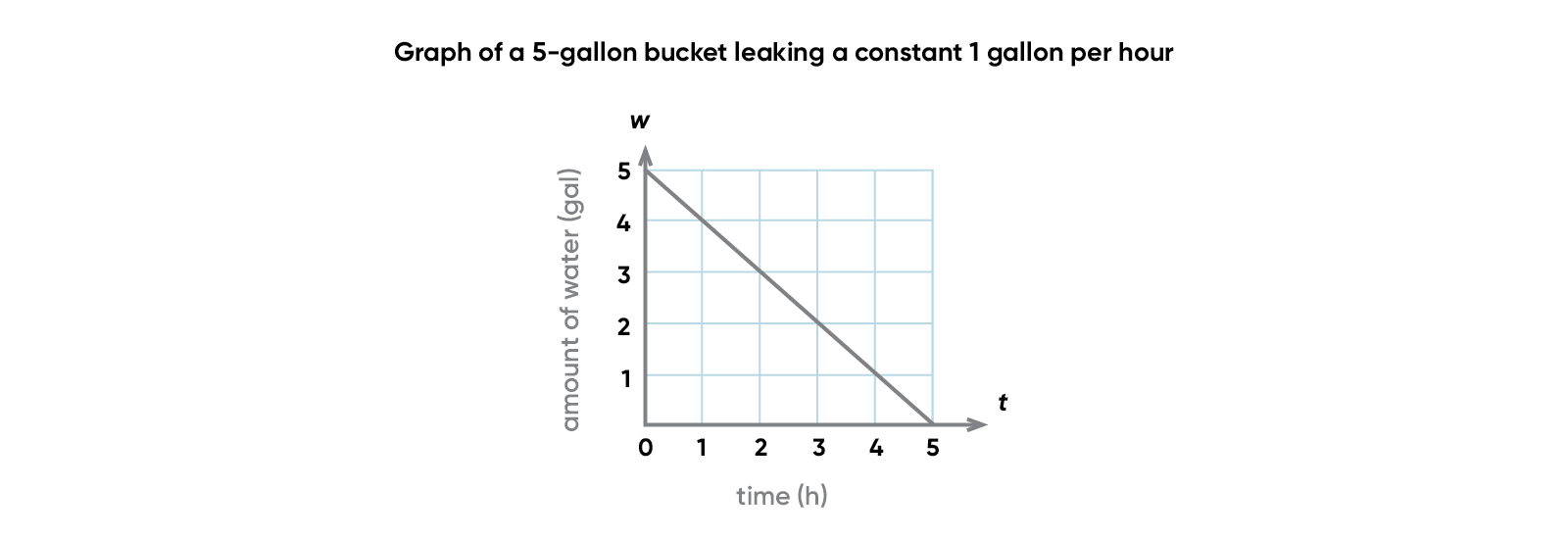
Case ii: amount of water in a leaky bucket = rate of leak × time
In this equation, since you won't always accept a negative amount of h2o in the bucket, the graph will show points only in the first quadrant. Notice that the direction of the line in this graph is top left to bottom right. Lines that tend in this management have negative slope. A negative slope indicates that the values on the y-axis are decreasing every bit the values on the x-axis are increasing.
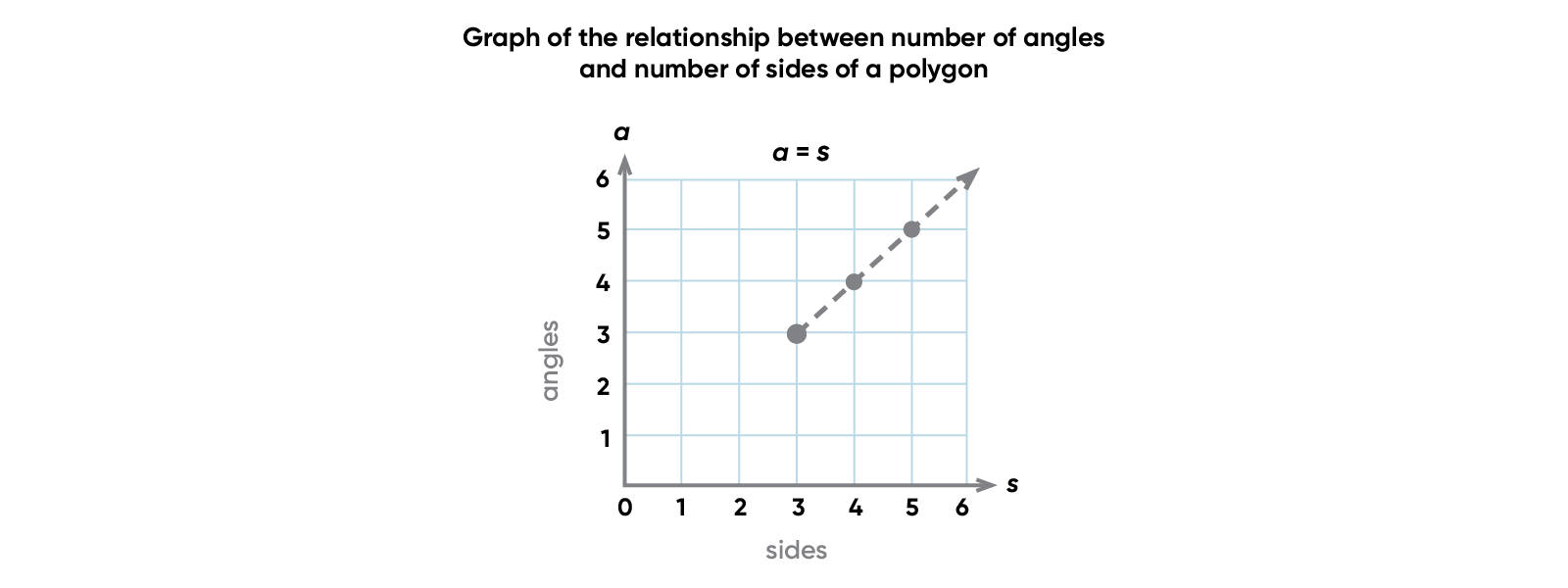
Case iii: number of angles of a polygon = number of sides of that polygon
Again in this graph, we are relating values that only make sense if they are positive, so we show points only in the first quadrant. Moreover, in this example, since no polygon has fewer than 3 sides or angles and the number of sides or angles of a polygon must exist a whole number, we show the graph starting at (3,3) and signal with a dashed line that points between those plotted are not relevant to the trouble.
Example 4: degrees Celsius = 5/9 × (degrees Fahrenheit – 32)
Since it's perfectly reasonable to have both positive and negative temperatures, we plot the points on this graph on the full coordinate grid. (Although it's not visible on the graph, the lowest possible physical temperature is around –460° Fahrenheit, and so non every solution on the graph is useful!)

Slope
The slope of a line tells two things: how steep the line is with respect to the y-axis and whether the line slopes up or down when you look at it from left to right. More technically speaking, gradient tells you the charge per unit at which the dependent variable is changing with respect to the modify in the independent variable.
Calculating Slope
Option any 2 points on the line. To find how fast y is changing, subtract the y value of the beginning point from the y value of the second point: (y two – y 1). To discover how fast 10 is changing, subtract the x value of the first point from the x value of the second point: (ten 2 – x 1). To discover the charge per unit at which y is changing with respect to the alter in x, calculate the ratio: (y 2 – y 1)/(x 2 – 10 1).

If we designate Bespeak A equally the offset point and Point B as the 2nd point, the slope of the line is (–2 – 4)/(–ane – 2) = –6/–3, or 2. Information technology does not thing which points along the line you lot designate every bit A and B, just as long every bit nosotros're consistent with which is the "first" point (10 i,y i) and which is the "second" (10 two,y 2). If nosotros designate Point B as the showtime signal and Point A as the second bespeak, the value of the slope is the same: (iv – -2)/(2 – -1) = six/3 or 2. It is likewise the same value you lot will go if you choose whatsoever other pair of points on the line to compute slope.

Linear Equation Formula
The equation of a line tin can exist written in a form that makes the slope obvious and allows you lot to depict the line without any computation. If students are comfortable with solving a unproblematic ii-step linear equation, they can write linear equations in gradient-intercept course. The slope-intercept form of a linear equation is y = k x + b. In the equation, ten and y are the variables. The numbers m and b requite the slope of the line (m) and the value of y when x is 0 (b). The value of y when x is 0 is called the y-intercept because (0,y) is the point at which the line crosses the y-axis.
You can draw the line for an equation matching this linear formula by plotting (0,b), and then using 1000 to detect another indicate. For example, if m is 1/2, yous can translate that equally a difference in one among y coordinates for every difference in ii among 10 coordinates (that is, (y 2 – y i)/(x 2 – x 1) = 1/two). Count +2 on the 10-axis, and then +i on the y-axis to go to some other point: (ii, b + 1).

The equation for this line is y + 3 = 2ten. In slope-intercept form, the equation is y = 2x – 3. In this form you lot tin can hands run across that the slope m = 2. Looking at the graph, the slope really is 2 since for every +2 change in y, there is a +1 change in 10. At present look at b in the equation: –3 should exist where the line intercepts the y-centrality, and it is.
Positive Slope
When a line slopes upwardly from left to right, it has a positive slope. This means that a positive change in y is associated with a positive change in ten. The steeper the gradient, the greater the charge per unit of change in y in relation to the modify in 10. A gradient of 6 is steeper than a slope of i, which is in plough steeper than a gradient of 1/vi. When the line represents real-world data points plotted on a coordinate plane, a positive gradient indicates a positive correlation, and the steeper the slope, the stronger the positive correlation.
Consider a linear equation where the independent variable g is gallons of gas used and the dependent variable d is the altitude traveled in miles. If you drive a big, old machine, you get poor gas mileage. The corporeality of miles traveled is depression relative to the amount of gas consumed, and so the value grand is a low number. The gradient of the line is fairly gradual. If instead you drive a light, efficient car, you get better gas mileage. You travel more miles relative to the same corporeality of gas consumed, so the value of m is greater and the line is steeper. Both rates are positive because yous still travel a positive number of miles for every gallon of gas you consume.

Negative Gradient
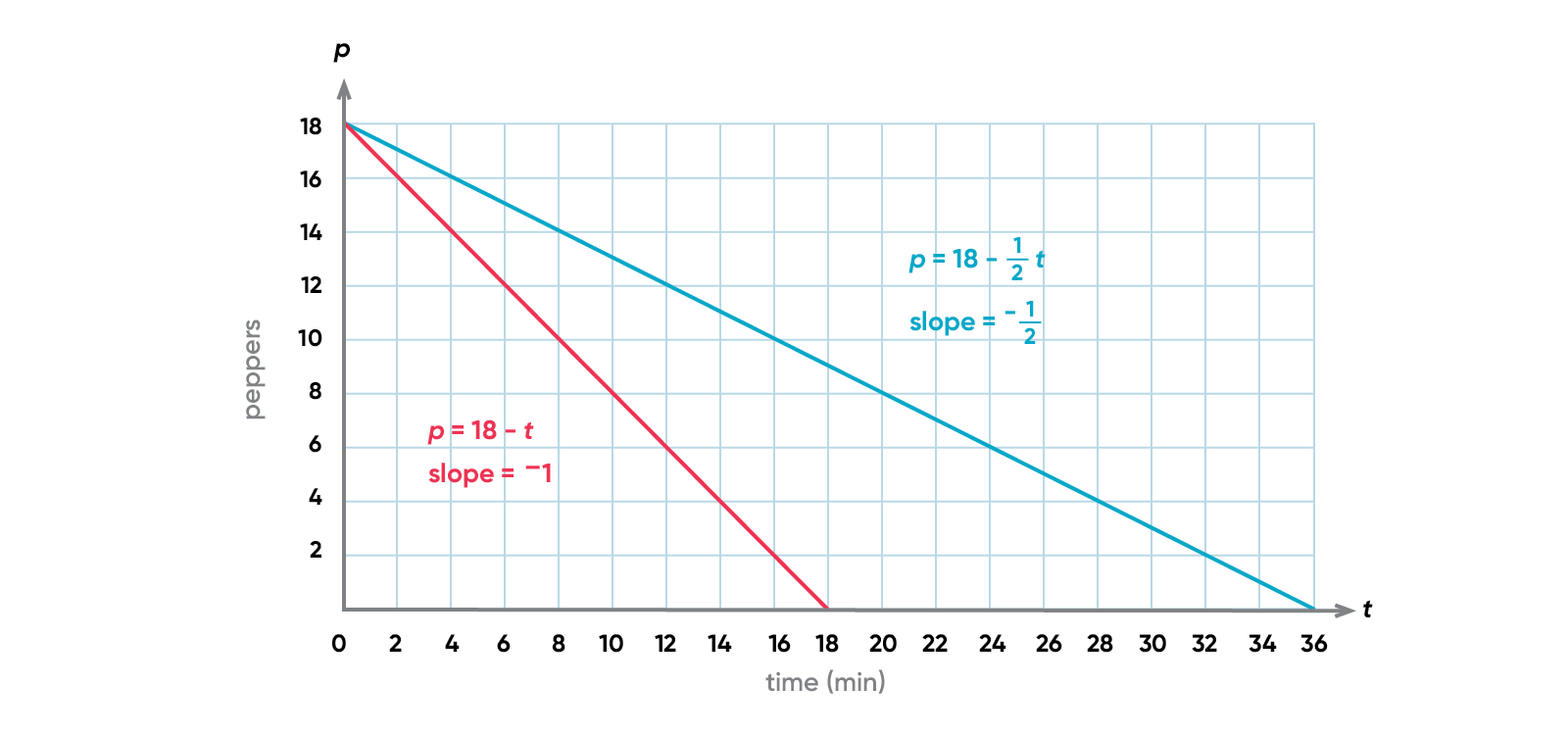
When a line slopes downwards from left to correct, it has a negative slope. This means that a negative change in y is associated with a positive change in x. When the line represents real-world information points plotted on a coordinate plane, a negative slope indicates a negative correlation, and the steeper the gradient, the stronger the negative correlation.
Consider a line that represents the number of peppers left to institute afterward minutes spent gardening. If the garden can fit 18 pepper plants, and you lot institute 1 pepper constitute per minute, the charge per unit at which the garden flat empties out is fairly high, then the absolute value of k is a greater number, and the line is steeper. If instead y'all only plant ane pepper plant every 2 minutes, yous nevertheless empty out the garden apartment, but the rate at which you lot exercise so is lower. The accented value of one thousand is lower (ane/two instead of 1), and the line is not as steep.
Naught Slope
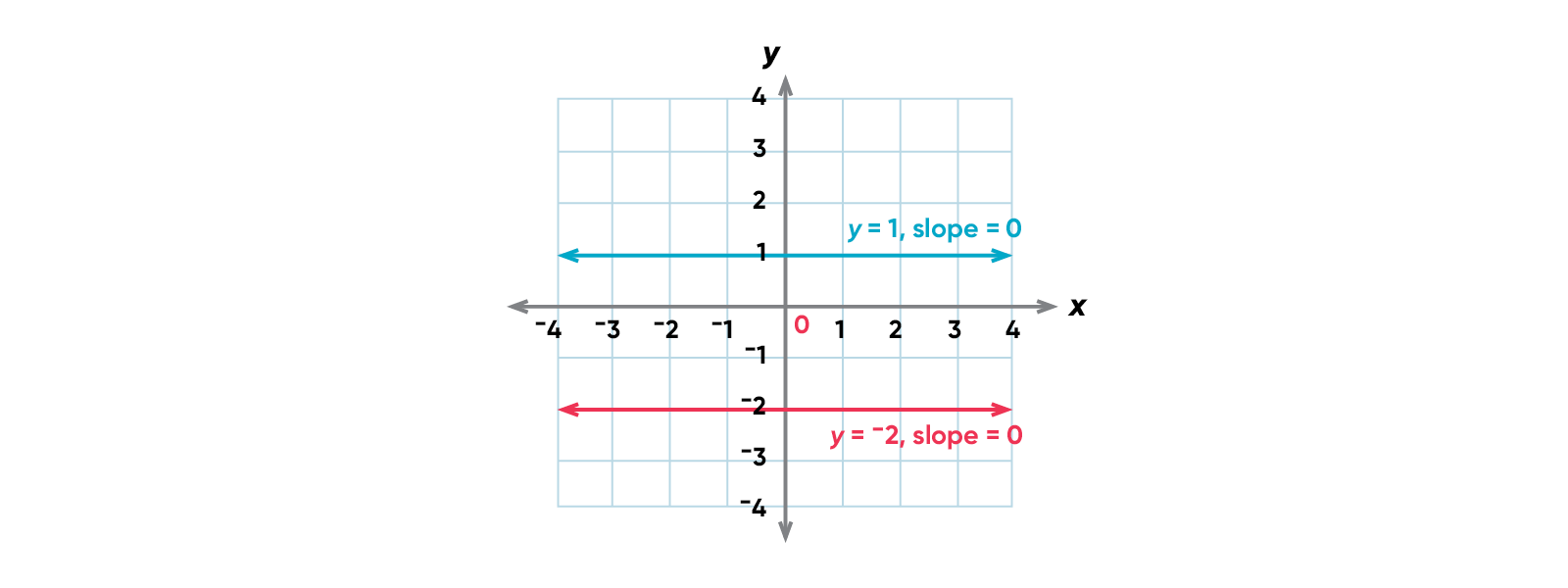
When there is no change in y as x changes, the graph of the line is horizontal. A horizontal line has a slope of aught.
Undefined Slope
When there is no change in x equally y changes, the graph of the line is vertical. You cannot compute the slope of this line, because you would need to divide past 0. Notice how yous tin can recollect of these lines as "infinitely steep," either positively or negatively. The slope of a vertical line is not defined.

Lines With the Same Slope
2 lines with the same slope have identical steepness. This means i of two things: either the lines are parallel or they're the aforementioned line.

In all three of these lines, every 1-unit of measurement change in y is associated with a 1-unit of measurement change in ten. All three accept a slope of 1.
Solving Two-Step Linear Equations with Rational Numbers
When a linear equation has two variables (as it commonly does), it has an infinite number of solutions. Each solution is a pair of numbers (x,y) that make the equation true. Solving a linear equation usually means finding the value of y for a given value of 10.
When the Equation Is Already in Slope-Intercept Grade
If the equation is already in the form y = mx + b, with 10 and y variables and g and b rational numbers, solving for specific values is straightforward. Choose a value for 10, and compute the corresponding value for y. You'll notice that an easy value to choose for x is 0, because in that case, y = b. Students may be asked to brand tables of values for linear equations. These are simply T-tables with lists of values for x with corresponding values for y.
Two-step equations involve finding values for expressions that have more than one term. A term tin be a number, a variable, or numbers and variables multiplied together. The terms in an expression are separated past addition or subtraction symbols. 2x is an expression with one term. ii10 + 6 has two terms. To find a value for y given a value for ten, substitute the x-value into the expression.
Consider the equation y = 210 + six. Find the value for y when x = v:
| Substitute the value for x into the equation. | y = two(5) + 6 |
| Multiply. | y = ten + 6 |
| Add. | y = 16 |
When the Equation Is Not in Slope-Intercept Form
When a linear equation is non in slope-intercept form (that is, not written every bit y = mx + b), students can nevertheless make a table of values to find solutions for the equation, but it may be simpler to put the equation in gradient-intercept form showtime. This requires mirroring operations on each side of the equation until y is by itself on the one side of the equation, prepare equal to a linear expression involving x. You tin manipulate the equation in this style because of equality properties:
- If a = b, and so a + c = b + c.
- If a = b, so a – c = b – c.
- If a = b, and then air conditioning = bc.
- If a = b, so a ÷ c = b ÷ c (so long as c ≠ 0).
Consider iix + y – six = 0. This equation is not in slope-intercept form, but yous can use equality properties to get y on one side of the equation.
- Y'all can subtract y from both sides of the equation to get 2x – six = –y. So multiply both sides of the equation by –1 to get –2x + half-dozen = y.
- Alternatively, you tin can decrease 210 and add six to both sides of the equation to get y = –twox + 6.
The two equations, –iix + vi = y and y = six – two10 are equivalent. You lot can turn one into the other by using the commutative property of add-on, which states that a + b = b + a, and the symmetric property of equality, which states that if a = b, and so b = a.
| Commutative Property of Addition | –2x + 6 = y is equivalent to vi – iix = y. |
| Symmetric Property of Equality | vi – twox = y is equivalent to y = 6 – iix. |
Linear Equations: Introducing the Concept
Materials: Coordinate grid that all students can see (grid should become at least from –10 to +ten on both axes), tool to marking up the grid with points and lines
Preparation: Since students will be reading points from graphs and graphing lines from lists of points, they (and you) volition demand to be prepared to apply a straightedge to generate accurate directly lines. If teaching online, use a digital tool capable of generating points and lines.
Prerequisite Skills and Concepts: Students demand to be able to plot points on a coordinate plane and should be familiar with the various ways to indicate multiplication and division in an equation. They should also exist familiar with the order of operations and the properties of equality.
- Carefully draw a line through (0,0) and (2,2) on the grid. Be certain to extend it in both directions then in that location are plenty of like shooting fish in a barrel-to-proper name points on it.
- Say: Proper name some points on this line.
Students should come up with a list of the points named by integer coordinates. If not, spend some time naming points on a grid before continuing with this lesson. If students name non-integer points, such as (1.five,1.5), spend time explaining why those are on the line likewise. - Enquire: Can you requite me a rule for how to find y when we know ten on this line?
Discuss how the coordinates are related, so ask students to write the dominion in equation form. The equation for this line is y = x. - Say: That was the line for the equation y = 10. H ow would you depict the line for the equation y = x + 3?
Have students independently try to draw the line. If viable, accept them pair upward and compare their lines. Facilitate a discussion around the different lines students drew, highlighting similarities and differences. Then show one way of drawing the line: substitute some values for x into the equation, find the corresponding values for y, and and so plot those coordinate pairs. Two points requite you enough information to draw the line, but considering mistakes are possible and human drawing isn't perfect, it is safer to generate at least 3 points. Display a T-table with the related x- and y-values, and depict the graph of the line. - Say: At present how would you draw the line for the equation y = 2x + three?
Students are likely to utilize the strategy of making a T-tabular array and computing points. If they forget to multiply their ten-values by 2 earlier adding iii, remind them well-nigh the guild of operations (multiply or divide left to right, then add or subtract left to right). Enquire dissimilar students to generate different points, talking through their reasoning as they go. - Enquire: Can someone give me a number between –v and v? Now, how about a number between –10 and 10?
Utilise these numbers to generate linear equations. The kickoff number volition be the coefficient of x, and the second will exist added to the 10 term. Generate equations, find points, then draw the lines. You can make this action more game-like by having students scroll real or virtual number cubes. If you lot've been working with slope, these bug will give y'all a chance to reinforce that concept as well. (Enquire: Practise you think the gradient of this line will exist positive or negative? Practise you call up it will be very steep or not and so steep? Will this line become through the origin?)
Linear Equations: Developing the Concept
Materials: Coordinate grid that all students tin can run across (grid should go at to the lowest degree from –10 to +x on both axes), tool to mark up the grid with points and lines
- Say When nosotros generated points for lines in our concluding lesson, our equations always looked the same. In other words, they were e'er in the same form. Today, we'll look at different ways they might look.
- Say Tin someone describe how to find some coordinate pairs for the linear equation, 210 + y = 15?
This is a ii-step equation. Solutions involve assigning a value to x, so multiplying this value by 2 earlier trying to figure out what value of y would satisfy the equation. Students can use trial and fault, or they can transform the equation using the equality backdrop:Write the equation. 2x + y = 15 Assign a value to 10. 2(3) + y = xv Multiply. half dozen + y = xv Decrease half-dozen from each side. 6 – six + y = 15 – half dozen Decrease. y = nine This solution gives us the point (iii,ix). Proceed finding solutions, or coordinate pairs, for this equation until you are satisfied that students are comfy with the process. And so, plot the points on your grid and draw the line.
-
Say Can someone draw how to find some points on the line described by the equation y + ten/3 = 5?
Write the equation. y + x/3 = 5 Assign a value to ten. y + 3/three = 5 Dissever. y + 1 = 5 Subtract i from each side. y + 1 – 1 = 5 – 1 Decrease. y = 4
This solution gives us the point (3,iv). Students may notice that this doesn't expect like previous linear equations. Explicate that because x/three is the same affair as (1/3)x, x/3 is notwithstanding an ordinary term. Continue finding solutions, or coordinate pairs, for this equation until you are satisfied that students are comfortable with the process. So, plot the points on your grid and depict the line. - Say Can someone describe how to find some points on the line described by the equation y – 6 = 2x?
Write the equation. y – 6 = iix Assign a value to 10. y – vi = 2(3)
Multiply. y – 6 = 6 Add 6 to each side. y – six + six = 6 + six Add. y = 12 This solution gives us the point (3,12).
- By now, students should have noticed that an piece of cake substitution for x is 0. This substitution will give y'all the indicate where the line crosses the y axis. Prompt students to come to this realization if they don't do so independently.
Assessment Hints
When students are solving multi-step equations, pay particular attention to whether they follow the society of operations. This is an important algebraic concept.
Likewise, watch for whether students really empathise that the equality properties say that if you practice something to one side of an equation, you MUST do the same thing to the other side of the equation. What you lot exercise is adamant by the action indicated by the equation. If a number is subtracted from y and you want y to be by itself, add that number to each side of the equation and its opposite appears to 'move' to the other side of the equation. Similarly, if y is multiplied by a number, division will help you become y by itself.
***
Looking for a solution for students in Grades five and upward that tin can help unlock learning for linear human relationship equations and formulas and beyond? Explore Math 180, a revolutionary approach to math intervention.
Be the beginning to read the latest from Shaped.
Source: https://www.hmhco.com/blog/teaching-linear-equations-in-math

Post a Comment for "Readings on Content Knowledge of Linear Equations and Functions for Students"