Baby Dear Born in the Spring , How Big Are They in September
White-tailed Deer
Odocoileus virginianus
Habitat: Field and forest edges, woodlands with an understory of herbaceous vegetation.
Weight:Males: 150 pounds (average); heavier weights are not uncommon; females: average 110 pounds.
Length: 71 inches; 39 inches high at the shoulder. Males are generally larger than females.
Food: Jump/summertime: grasses and forbs; fall: acorns, other mast items, and apples; winter: twigs and buds from a broad diverseness of hardwood trees and leaves from conifer trees such every bit white pine and hemlock.
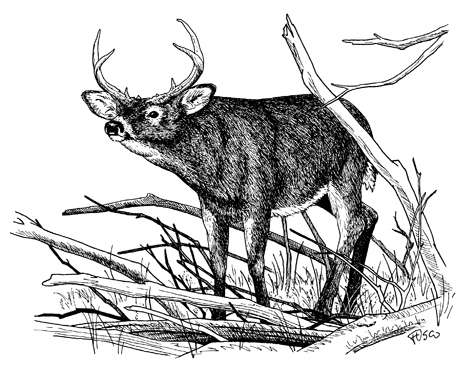
Identification: The white-tailed deer is a stately, graceful animal distinguished by conspicuous ears, long legs, and narrow, pointed hooves. Adult males have spreading, branching antlers. The most noticeable feature is the tail, which is brownish above and white underneath. When the beast is alarmed, the tail is raised loftier, revealing a white "flag" equally the deer bounds off through the woods.
White-tailed deer vary seasonally in coloration. Their summer glaze is reddish-brown to tan and is composed of brusk, thin hairs. The winter coat is grayish-dark-brown to gray, with long, thick hairs. Fawns are reddish-brown with white spots, which they lose when they are three to four months one-time, ordinarily past the end of August in Connecticut.
Range: White-tailed deer are found over nigh of southern Canada and the United States (except for most of California, Nevada, and Utah) and due south to Panama.
Reproduction: The mating or rutting season starts in belatedly October and extends through early January. In Connecticut, the tiptop of the rutting season is the last two weeks in Nov. Fawns, weighing from four to eight pounds, are ordinarily built-in in June. They remain nether the female's care through September, when they are weaned. The number of young born ranges from one to four, depending upon the age and condition of the doe. In Connecticut, twins are common and triplets and quadruplets have been recorded. Female fawns built-in early in spring have the potential to brood by the post-obit autumn.
History in Connecticut: Due to over-harvesting for venison and deerskins, market hunting, and a general loss of deer habitat caused by extensive clearing of the land for farming, white-tailed deer were uncommon in Connecticut from 1700 to approximately 1900. The numerous laws enacted during this menstruum to protect the dwindling deer resources, plus the improvement in deer habitat as farms were abased, contributed to a slow but steady rebound in deer numbers. In 1907, legislation was passed allowing landowners to shoot deer causing crop damage on their state. Since so, harvest regulations have been gradually liberalized to deal with the growing herd and increasing deer damage problems. In 1974, Connecticut passed the Deer Direction Human action and, in 1975, held its first deer firearms hunting season, irresolute the status of white-tailed deer from agricultural nuisance to valuable game animal. The deer population continues to increase, every bit deer benefit from human being'due south land apply activities, evidenced past their accommodation to manicured suburban environments and the clearing of forests for timber harvest and cordwood cut.
Interesting Facts: Male person white-tailed deer grow and shed antlers annually. The antlers begin to grow in Apr or May. They are soft and covered with a sensitive tissue known equally velvet. By fall, the antlers harden; the deer scrape them against saplings to remove the velvet in preparation for the estrus. Antlers are used in sparring during the mating season. They are shed from mid-December to belatedly-Jan. Antler size is determined by age, genetics, and nutritional value of the deer's diet.
Ofttimes, well-meaning people find a fawn alone in the woods and bring it domicile without realizing that the doe was nearby all the fourth dimension. To divert the attending of predators, female person deer only visit their fawns iii or iv times a day, for most 15 minutes per visit, in order to feed them. Not only is removing a healthy fawn from the wild illegal, but it also reduces the creature's chances of survival. To help a fawn that has definitely been abandoned or injured, contact the Wildlife Partitioning for the name of a licensed rehabilitator in your area. These trained volunteers are the only people who tin can legally rehabilitate wildlife in the state.
Management of Nuisances: Nuisance deer can exist controlled using a number of methods, such as fencing, repellents, and preventive measures.
Fencing : Electric high-tensile wire fences such as the 7-strand slant wire, the half dozen-wire vertical fence, and others have been designed to protect crops from deer damage. Spacing betwixt wires should exist about eight to 10 inches and any brush around the fence should exist cleared away. The type of fence to construct depends on such factors every bit terrain, vegetation, location, and deer density. For more than detailed information on electric fences, contact the Wildlife Division.
Woven-wire fences may also exist used to keep deer out of an area, and cattle fencing or craven wire fences will work if constructed viii to 10 feet high. Wire strands strung in a higher place the woven wire can add together more acme if desired. Wire mesh fences may be erected effectually private ornamentals or other plants you might wish to protect from deer browsing.
Repellents : The utilize of repellents can be costly because they must be re-practical post-obit rain. In areas of loftier deer density and express nutrient resource, repellents have little value. Home remedies such equally bone meal or human pilus tied in sacks hung from trees take been used with limited success. Soap has recently become a popular abode remedy in northeast orchards. Taste and odor repellents have been used with varying degrees of success.
Preventive Measures : Plant loftier-value crops away from woods, shrub rows, or other deer cover. Ornamentals that are unpalatable to deer should be planted in areas discipline to deer damage. Persimmon, lilac, boxwood, jasmine, holly, pepper tree, wax myrtle, century plant, and narcissus are just a few of the plants that can be considered.
Population Reduction : Farmers who are experiencing deer harm problems would be wise to encourage hunting on their belongings during the regulated deer seasons. The only practical way to command free-ranging deer herds in the land is past harvesting animals each twelvemonth to aid curb population expansion and maintain the deer herd at a level uniform with the habitat and farming interests.
Population Management : Because deer have a high reproductive potential and few natural predators, deer populations have the potential to increment rapidly. In the absence of pregnant mortality, deer populations tin can double in size in two years. High deer populations can significantly modify forested habitats reducing establish diversity and habitat suitability for other wildlife species. In addition, deer can affect flower and vegetable gardens, mural plantings, and pose a threat to motorists on Connecticut roadways. The Wildlife Segmentation recommends the employ of regulated and controlled hunts to effectively and efficiently reduce and maintain deer populations in rest with cultural and habitat conveying capacities.
More data on crop damage and white-tailed deer control.
 The Technical Help Advisory Series is 75 percent funded by Federal Aid to Wild animals Restoration - Pittman-Robertson (P-R) Programme. The P-R Programme provides funding through an excise tax on the auction of sporting firearms, ammunition, and archery equipment. The remaining 25 percent of the funding is matched by the Connecticut Wildlife Partition. (rev. 12/99)
Source: https://portal.ct.gov/DEEP/Wildlife/Fact-Sheets/White-tailed-Deer

Post a Comment for "Baby Dear Born in the Spring , How Big Are They in September"